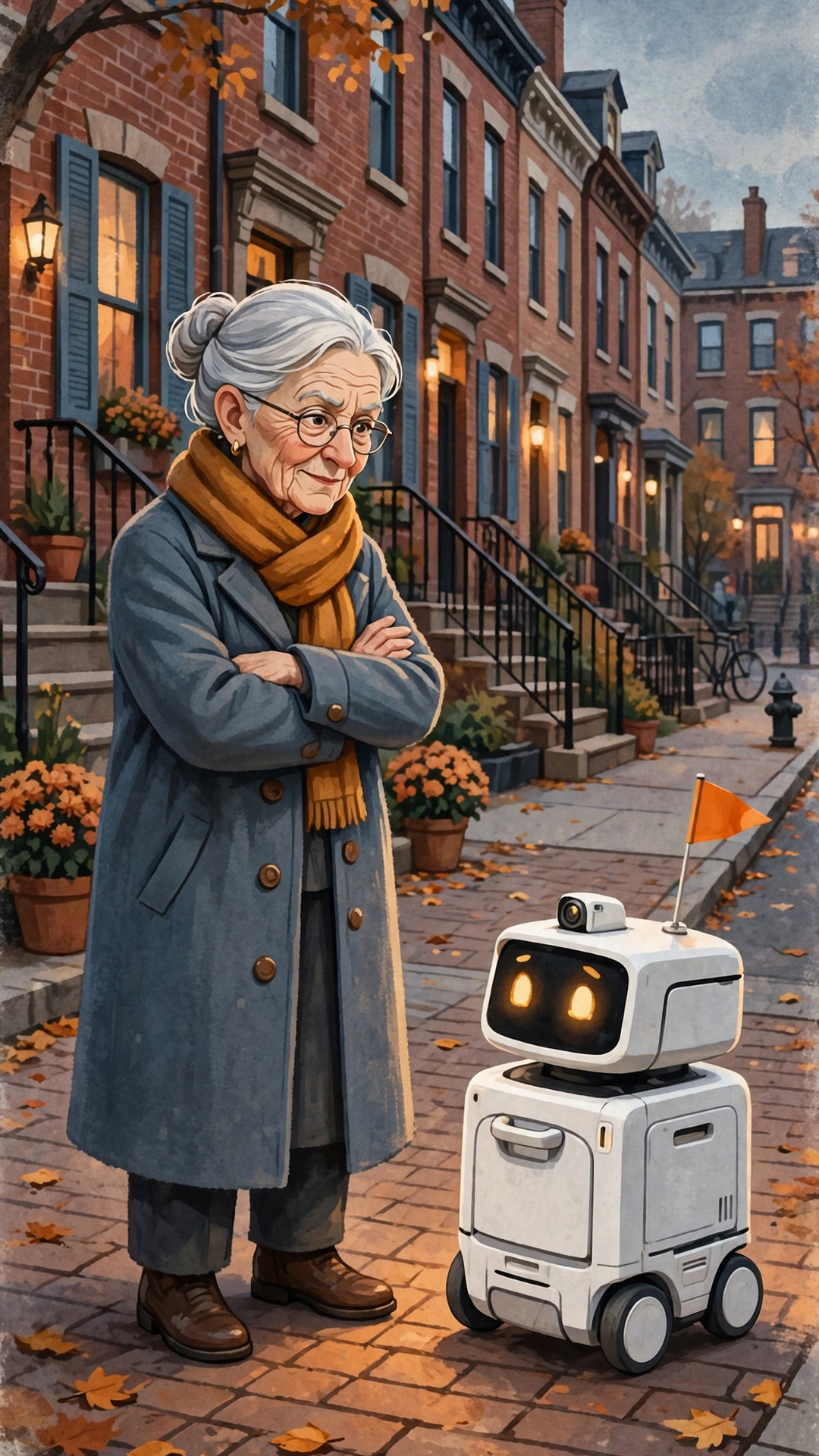
A seventy-eight-year-old retired professor in Philadelphia has declared war on the delivery robots.
She does not hack them. She does not tip them over. Her weapon of choice is considerably older than the robots are, and considerably harder to patch: she stands in front of them, and she refuses to move.
And the robots — this is the part that should worry the robots — are winning on a technicality.
This is Told As Told, our series for the stories people swear are true, riding the Lighter Side this time. But don't let the comedy fool you. Underneath the funniest standoff in Philadelphia this year sits a genuinely strange legal idea, a citation with a future in trivia nights, and a question about the sidewalks that every city in America is going to have to answer sooner or later.
THE PROFESSOR
Carolyn Marvin taught communications at the University of Pennsylvania.
Sit with that for a second, because the casting could not be better if it had been written. A communications professor spends a career studying how messages move through a society — who gets heard, who gets the floor, what it means when a new voice arrives and starts talking in a space that used to belong to somebody else. Then, in retirement, a fleet of machines rolls into her city claiming a share of the sidewalk, and the professor does what communications scholars almost never get to do.
She filed her objection in person. With her body. On the pavement.
These days, her hobby is standing in front of Uber Eats' sidewalk delivery robots — and refusing to move. Just that. One retired professor, planted in the path of the future, conducting a one-woman peer review of the twenty-first century.
THE SIDEWALK QUESTION
Before the war, the question — because underneath the comedy, this story is a question wearing a costume.
A sidewalk is some of the most contested ground in any city, and most of us never notice. It's where the walkers walk, yes, but it's also where the café puts its tables, where the shop puts its sign, where the kid chalk-draws and the busker plays and the whole unscripted life of a neighborhood happens at four miles an hour. For as long as there have been sidewalks, every inch of that territory belonged, by universal assumption, to people — and to the animals and objects people brought with them, on the people's terms.
Then commerce found a new use for it. Not a storefront on the sidewalk. The sidewalk itself, as a road — a delivery lane for machines that travel it end to end, all day, carrying dinner. Nobody knocked on the neighborhood's door. The lane simply opened, the way a new lane opens on a highway, except this highway runs past your front step, and the vehicles on it are the size of a suitcase and twice as determined.
Somebody in Philadelphia was bound to object eventually. It matters that the somebody turned out to be a communications professor — a woman who spent her professional life on the question of who gets the floor. Because that's exactly what a sidewalk is, in the end: the public's floor. And her objection, when it came, was not a lawsuit or a letter to the editor.
It was an occupation. One woman, one robot-width of pavement, held indefinitely.
THE WAR
She's been doing it since the fleet rolled into Philly in March.
Understand the tactical picture, because it is funnier the longer you look at it. A delivery robot is a machine built to be polite. Its entire personality is courtesy software: it rolls up to an obstacle, it stops, it waits, it reroutes if it can, and it does not, under any circumstances, make a scene. It has no horn to lean on and no opinion to defend. Against a human being who has simply decided to become scenery, the robot has exactly one move, and the move is patience.
Marvin, on the other hand, has nothing but time — and a lifetime of practice at holding a room.
So the standoff repeats, robot after robot, month after month: the machine waiting with the infinite politeness of something that cannot get annoyed, and the professor standing with the infinite stubbornness of someone who has graded freshmen for decades and cannot be waited out by a cooler on wheels. It is the unstoppable force meeting the immovable object, except the force is stoppable by design and the object is seventy-eight and just getting warmed up.
Every war, though, eventually produces an incident. This one produced its incident in the middle of October.
OCTOBER 14TH
On October 14th, it caught up with her: handcuffed on her way home from a flu shot, takeout in hand, cited for disorderly conduct.
Some stories you couldn't improve with a writers' room. The flu shot. The takeout. A professor of communications, cuffed mid-errand, holding dinner, for the crime of standing still in the wrong futuristic place. If she'd set out to design the perfect arrest photograph for the age of automation, she could not have art-directed it better than her own Tuesday did by accident.
A friend of hers delivered the citation's unofficial translation, and it deserves to outlive the citation itself: "a disorderly conduct charge for impeding capitalism."
There it is, the whole war in one line. Because that's exactly what the standoff looks like from the sidewalk: the largest forces in the modern economy — venture capital, logistics networks, the entire app-ified future of dinner — brought to a complete standstill by one woman who declined to step aside. Capitalism, impeded, by a grandmother-shaped roadblock, on her way home from preventive healthcare, carrying a bag of food that was presumably delivered the old-fashioned way: by her.
THE STARE-DOWN ECONOMY
It's worth understanding why her tactic works, because it works on the whole industry at once.
A delivery robot is not cheap, and it is not fast, and its entire business case rests on a delicate piece of mathematics: the machine must complete enough deliveries, without incident, to be worth more than the human courier it replaced. Every minute a robot spends politely stopped in front of a retired professor is a minute it is not earning. It cannot argue. It cannot edge past without risking the one headline no delivery company on Earth wants. It can only wait — burning battery, burning schedule, burning the thin margin the whole model stands on.
Marvin figured this out, whether she ever wrote it down or not. She is not fighting the robots one at a time, really. She's demonstrating, with her own body as the chalkboard, the single soft spot in the entire sidewalk-delivery idea: it only works in a world where people agree to step aside. The moment one person declines — politely, peacefully, immovably declines — the future has to stop and wait for the past to finish standing there.
There are worse ways to make a point. There are certainly more expensive ones. Hers costs a flu shot's worth of schedule disruption and one citation, and it has now been covered by national television. As protests go, the efficiency is honestly impressive.
HER DEFENSE
And then she said the thing that elevates this from a cute local story into a document of our era. Her defense might be the quote of the year:
"I was under the impression that I had more rights than the robot did."
Read it twice. It is perfectly reasonable. It is, in fact, exactly the assumption every human being over the age of six walks around with: that on a sidewalk, in a contest between a person and a machine, the person outranks the machine. That flesh and blood holds seniority over plastic and lithium. That if anybody in this arrangement has the right of way, it is the creature with the soul.
She was under that impression. The word doing all the work in that sentence is was.
Because here's the twist — she doesn't.
THE TECHNICALITY
A 2020 Pennsylvania law classifies those robots — "personal delivery devices" — as pedestrians.
Pedestrians.
Not vehicles. Not appliances. Not cargo. Under the law of the Commonwealth of Pennsylvania, a delivery robot rolling down the sidewalk is a pedestrian, with a pedestrian's standing in the world. Which means that every time Carolyn Marvin planted herself in front of one and refused to move, the law did not see a citizen protesting a machine.
Legally, she wasn't blocking a machine. She was blocking a pedestrian.
Roll that around your head. In the eyes of the law, the robot was a neighbor out for a stroll, and the professor was the obstruction. The machine had the rights. The human had the citation. Her defense — I was under the impression that I had more rights than the robot did — turns out not to be a defense at all. It is a confession that she had not read the one statute that mattered, passed six years before her war began, quietly reclassifying the future as a fellow walker.
Nobody voted on that idea in any way the public remembers. There was no great civic argument about whether a burrito with a motor counts as a person for sidewalk purposes. The law just arrived, the way the robots arrived: one spring, they were simply there, and the legal ground under everyone's feet had already been re-paved to receive them.
That is why this silly story matters. The question Marvin stumbled into — who does the sidewalk belong to, and what counts as a pedestrian on it — is not a Philadelphia question. It's an everywhere question, arriving everywhere at twelve miles an hour with somebody's lunch inside. Philadelphia just happens to have the most entertaining test case.
WHAT EACH SIDE KNOWS
Here's the final irony, and it's a genuine one. Both parties in this war understand the other perfectly.
The robot's makers know exactly what Marvin is: the scenario their politeness software was built to absorb. The stopped robot is not a malfunction; it's a feature, photographed. The machine is designed to lose every confrontation, gracefully, because the alternative — a machine that insists — is the one outcome the whole industry cannot survive. Marvin isn't exploiting a bug. She's using the product as intended, against its owners, at a pace set entirely by her.
And Marvin knows exactly what she is in the eyes of the law: not a protester, not a pedestrian's equal, but an incident — an obstruction logged against a machine that outranks her. She read the citation. She heard the statute. Her war continued anyway, which tells you the war was never really about the statute. It's about the assumption underneath it — her assumption, stated in her own defense, that a person ought to outrank a lunchbox on the ground where people walk. The law says the impression is outdated. She is standing in the street, declining to update it.
"OH YEAH"
Every good standoff story ends with the same interview question, and CNN asked it: will she block another one?
Her answer, in full:
"Oh yeah."
Two words, and a whole philosophy in them. No hedging, no legal review, no retirement announcement, no we'll see how the citation plays out. Seventy-eight years old, already handcuffed once, fully informed that the law considers her the obstacle and the robot the citizen — and the answer is oh yeah, like she'd been asked whether she wanted coffee.
So — team professor, or team robot? Because in Pennsylvania, the robot is a pedestrian, and she is a traffic incident. The law has picked its side. The professor has picked hers. The robots, presumably, are still out there rolling patiently around Philadelphia, and somewhere in front of one of them, sooner or later, stands a retired communications scholar with nowhere she needs to be.
You decide.
Watch the telling: our animated version of this story is live on TikTok and YouTube at Team Murphy Media 302. Sources: the story as told in our animated telling; reported by CNN, October 31, 2026. Art: cover illustration from the Told As Told animated telling of this story, created in-house for Team Murphy Media 302 (illustration, not a photograph).